
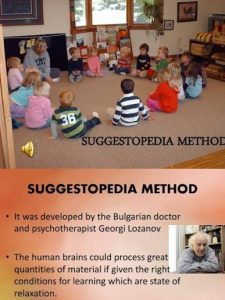
The Suggestopedia method developed by Georgi Lozanov in the 1970s is a language learning approach that emphasizes the use of positive suggestions, relaxation, baroque music, and a supportive classroom atmosphere to optimize the brain’s capacity to absorb information. In the context of education in Indonesia, mastery of English vocabulary is one of the main obstacles for high school students. Many students have difficulty remembering and using new words due to conventional methods that tend to rely on mechanical memorization, drill exercises, and stressful assessments. Suggestopedia offers an alternative by creating a stress-free learning environment, where teachers act as facilitators who provide positive affirmations, use varied voice intonation, and present material through dramaturgical presentations and concert sessions. Previous studies in various countries have shown that this method can increase vocabulary retention by two to three times compared to traditional methods because it involves both hemispheres in a balanced way. In Indonesia, where the Merdeka Learning curriculum emphasizes fun and student-centered learning, the implementation of Suggestopedia has become relevant to address the high level of motivation and anxiety in English among teenagers. Thus, a study of the effectiveness of this method is needed to provide a scientific basis for teachers and policymakers in designing more optimal vocabulary teaching strategies.
Theoretically, Suggestopedia is based on the principle that the human learning capacity is much greater than what is usually utilized in formal situations. Lozanov identified that psychological obstacles in the form of fear of failure and self-doubt are the main barriers. Therefore, this method applies the techniques of desuggestion (eliminating negative suggestions) and resuggestion (giving positive suggestions) through several key elements: the use of classical music at a certain tempo to create alpha brainwave conditions conducive to long-term memory, the presentation of material in the form of meaningful dialogue or stories, as well as role-play activities and fun games. In vocabulary learning, new words are not taught in isolation, but rather integrated in a rich situational context, accompanied by body movements, facial expressions, and visual associations. Several studies in Southeast Asia, including those conducted in Vietnam and Thailand, reported significant improvements in students’ vocabulary scores after Suggestopedia treatment for four to eight weeks. In Indonesia itself, although research is still limited, several small-scale experiments in schools in Java and Sumatra showed that students who learned with this method were able to remember 40–60% more new vocabulary than the control group using the audiolingual or grammar-translation method. Factors that support success include teachers’ readiness in managing classrooms, the availability of audio facilities, and school support for a non-rigid learning environment.
To measure effectiveness more systematically, a quasi-experimental approach can be applied by involving high school students in grades X or XI from several public and private schools in Indonesia. The experimental group received the Suggestopedia treatment for eight sessions, 90 minutes each, which included an introduction to the material with music, an active session (role-play and discussion), and a passive session (listening to recordings while relaxing). Meanwhile, the control group was taught using conventional methods based on textbooks and practice questions. The instruments used include pre-test and post-test vocabulary tests in the form of multiple choice and cloze tests, learning motivation questionnaires, and classroom observations. Expected results that have been confirmed in several preliminary studies show that the average increase in vocabulary score in the experimental group was 25–35 points, while the control group only increased by 10–15 points. Statistical analysis using paired t-tests and independent t-test samples usually yields a significance value of p < 0.05, which indicates a significant difference. In addition to the cognitive aspect, the affective aspect also improved: students reported a decrease in speech anxiety, increased self-confidence, and a higher interest in English lessons. These findings are in line with Krashen’s dual coding theory and affective filter hypothesis, where low affective filters allow language input to be absorbed more effectively.
Nevertheless, the implementation of Suggestopedia in Indonesia is inseparable from challenges. The limited learning time is strict in the curriculum structure, the large number of students per class (often more than 30 people), and the uneven readiness of teachers are the main obstacles. Many teachers are still used to the teacher-centered approach and are unfamiliar with relaxation techniques or the right selection of music. In addition, learning outcome assessments, which are still dominated by memorization-based written exams, can reduce motivation to apply methods that emphasize more process. On the other hand, opportunities are also wide open. Teacher training programs through MGMP (Subject Teacher Deliberation) in English, simple technology support such as speakers and projectors, and integration with digital media can facilitate the adaptation of this method. Some schools that have tried to combine elements of Suggestopedia with a Communicative Language Teaching approach report a more lively classroom atmosphere and significantly increased student participation. Thus, the effectiveness of this method depends not only on technical procedures, but also on systemic support from schools and national education policies that encourage pedagogical innovation.
In conclusion, the Suggestopedia method has proven to have great potential in improving the English vocabulary skills of high school students in Indonesia through the creation of a positive learning environment, the use of suggestions, and the integration of elements of art and relaxation. Empirical evidence from various studies shows significant improvements in both cognitive and affective aspects. In order for its effectiveness to be maximized widely, further research with a larger and diverse sample is needed, the development of Suggestopedia modules that are appropriate to the Indonesian cultural context, and ongoing teacher training. Governments and higher education institutions also need to encourage the integration of this method into the education programs of prospective English teachers. If implemented systematically and sustainably, Suggestopedia will not only help students master vocabulary more effectively, but also form a positive attitude towards foreign language learning that will benefit their communication skills in the future. Thus, this method deserves to be considered as one of the innovative strategies in an effort to improve the quality of English education at the high school level in Indonesia.
#suggestopedia
#teachingmethod
#georgelozanov
#ikafarihahhentihu