
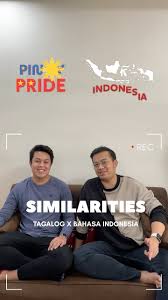
Tagalog, which is the basis of the official language of the Philippines (Filipino), often surprises many Indonesians or Javanese speakers when they first hear it. Many words sound familiar, even almost identical in pronunciation and meaning. This is not a mere coincidence, but strong evidence of deep common roots in the Austronesian language family. This language family is widespread from Taiwan, through the archipelago, to the Pacific, brought by ancient sailors and migrants thousands of years ago. Indonesian (Malay-based), Javanese, and Tagalog are all part of the Malayo-Polynesian branch. These similarities include basic vocabulary of everyday life, grammatical structures, and phonological patterns that still resonate with each other despite being geographically and historically separated for centuries. For visitors to Linguazona.com, this phenomenon is an interesting gateway to understand how language reflects the history of Southeast Asian maritime civilization.
One of the main reasons for the similarities is the common Proto-Austronesian heritage. Linguists reconstruct that the ancestors of these languages had a similar core vocabulary for basic concepts such as family, nature, and numbers. For example, the “eye” (eye) is exactly the same in all three; “child” is almost identical; “bulan” (month) becomes “bulan” in Tagalog; “five” (five) remains “five”; “pito/pitu” for seven; and “walo/eight” for eight. Javanese, especially the ngoko (colloquial) level, bears a closer resemblance to Tagalog than modern Malay in some cases, such as “asu/aso” for dog or “manok” which in Tagalog means chicken. This similarity is even stronger due to the historical influence of trade and the kingdoms of the archipelago. The kingdoms of Srivijaya and Majapahit, as well as Malay-Brunei influences, brought a lot of vocabulary to the Philippines, including cultural, trade, and even religious terms before Spanish colonialism dominated.
In addition to vocabulary, linguistic structure also shows interesting parallels. All three tend to use affixes (suffixes) to change the meaning of words, although Tagalog relies more on a complex verb focus system (voice system). The pattern of reduplication (repetition of syllables) to express intensity or plural is also common, as in the formation of verbs or adjectives. Sanskrit and later Arabic and European influences added a similar layer in all three languages, albeit with local adaptations. However, differences arise due to geographical isolation and different colonial contacts: Tagalog absorbs a lot of Spanish and English, while Indonesian and Javanese are influenced by the Dutch and other regional languages. However, Indonesian speakers who learn Tagalog often find it “easy” to recognize 20-30% of basic vocabulary, enough for a simple conversation about food, family, or direction. This phenomenon of partial mutual intelligibility is living proof that the boundaries of modern states do not always correspond to ancient linguistic lines.
Ultimately, the similarities between Tagalog, Javanese, and Indonesian teach us about a deeper unity in Southeast Asia. In the era of globalization, understanding this linguistic bond not only enriches knowledge but also builds bridges between cultures. For Linguazona.com community, explorations of topics like this remind us that language is a living archive of the history of migration, trade, and the exchange of ideas. When we hear similar “expensive” or “cheap,” we are actually hearing echoes of the same Austronesian ancestors. Let’s continue to celebrate this diversity as well as unity through a more in-depth linguistic study, because every word alike is an invitation to dialogue across islands and across generations.
#filipino
#tagalog
#javanese
#ikahentihu