
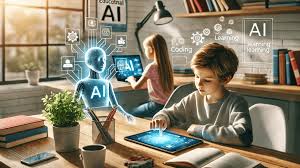
The era of artificial intelligence (AI) has changed almost every aspect of human life, and the world of education is one of the most profoundly affected sectors. In the past, education was synonymous with traditional classrooms, thick textbooks, and teachers standing in front of a blackboard. Today, AI delivers a personalized, adaptive, and much more efficient learning experience. Platforms like Duolingo, Khan Academy, and ChatGPT have proven that machines can be 24-hour personal tutors. In Indonesia, the government through the Ministry of Education and Culture has begun to integrate AI in the Merdeka Learning curriculum, while many private schools are already using AI-based learning systems to analyze student progress in real-time. This revolution is no longer the future, but an ongoing reality, where the boundaries between humans and technology in the learning process are increasingly blurred. Education in the AI era promises equal access to knowledge, but it also brings ethical and social challenges that must be addressed immediately so as not to leave some people left behind.
One of the most tangible impacts of AI in education is the personalization of learning. Each student has a different pace, style, and interest in learning. AI systems are able to analyze learning behavior data, identify weaknesses, and organize the right materials according to individual needs. For example, if a student is having trouble understanding algebraic math, the AI can provide additional exercises with visual explanations or interactive videos until the concept is mastered. At the college level, AI helps lecturers design dynamic curriculum and even grade student assignments with high accuracy. In Indonesia, AI pilot projects in several schools in Jakarta and Yogyakarta have shown an increase in learning outcomes of up to 30 percent in a short period of time. However, this personalization also raises concerns: are teachers still needed? The answer is yes, because AI has not been able to replace empathy, emotional motivation, and character formation that only human educators can do. Teachers in the AI era are transforming into facilitators and mentors, not just conveyors of information.
The biggest challenge for education in the AI era is the digital divide and human resource readiness. Not all regions in Indonesia have stable internet access or adequate technological devices. Students in remote areas often rely solely on conventional learning, while students in big cities already enjoy advanced AI features. In addition, many teachers have not been trained to use AI tools, so there is resistance and fear that their work will be replaced. The government needs to accelerate digital teacher training programs and provide equitable infrastructure. On the other hand, AI also has the potential to exacerbate inequality if only the wealthy can access premium paid platforms. Therefore, collaboration between the government, the private sector, and educational institutions is crucial to create an inclusive education ecosystem. Without this strategic step, AI could actually widen the gap between those who are rich in knowledge and those who are left behind.
In the midst of these challenges, the opportunities offered by AI are enormous. AI can democratize quality education by providing free courses from the world’s top universities through platforms like Coursera or edX. In Indonesia, initiatives such as Ruangguru and Zenius have combined AI to make learning more engaging through gamification and smart content recommendations. In addition, AI helps students with special needs, such as the blind or visually impaired, with customized text-to-speech and adaptive learning features. The future of education will also see the emergence of new majors such as “AI Ethics” and “Prompt Engineering” that prepare the younger generation for an increasingly automated world of work. Most importantly, AI encourages lifelong learning, where adults can continue to improve their skills without having to go back to formal schooling. Thus, AI is not a replacement for humans, but rather a tool that strengthens the potential of humans to learn faster and deeper.
Welcoming 2030 and beyond, education in the era of artificial intelligence must be designed with a wise vision. The right approach is human-centered AI, where technology supports, rather than dominates, the educational process. The Indonesian government needs to draft clear regulations on the use of AI in schools, including student data protection and plagiarism prevention. Teachers and parents must be taught AI literacy from an early age in order to guide children appropriately. Meanwhile, students need to be equipped with not only technical knowledge, but also 21st-century skills such as critical thinking, creativity, and ethics. Education in the AI era is ultimately not about who is the best at using technology, but rather how it helps create a generation that is more humane, adaptive, and ready to face global challenges. With the right steps, Indonesia can become one of the countries that successfully utilizes AI to educate the nation’s life, making education the main foundation towards a Golden Indonesia 2045.
#AI
#duolingo
merdekalearning
#ikahentihu