
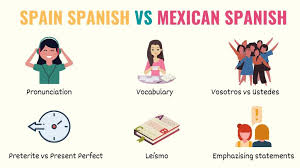
Spanish is one of the most widely spoken international languages, with more than 590 million speakers worldwide. Although it comes from the same root of the Castilian language, the variants that developed in Spain (Europe), Mexico, and Argentina show significant phonological, lexical, grammatical, and pragmatic differences. These differences arise due to the process of colonization, contact with indigenous languages, immigration, and geographical isolation. From the perspective of linguistic variation, these three variants are mutually intelligible, but the differences are striking enough to affect learning, translation, and cross-cultural communication strategies. This article compares the three objectively to provide an in-depth understanding for language learners, educators, and researchers.
The Spanish variant in Spain (Castilian Spanish) is often considered the standard European form. The most prominent feature is the distinción, which is the pronunciation of the letters c (before e/i) and z as the interdental sound /θ/ (similar to “th” in English “think”), while s is pronounced /s/. This distinguishes it from most Latin American variants that use seseo (all pronounced /s/). Grammatically speaking, European Spain uses vosotros for you (informal plural), and more often retains the use of leísmo or a different past tense. Typical vocabulary includes ordenador (computer), patata (potato), coche (car), and bolígrafo (pen). The accent tends to be more assertive with a clear vocal emphasis, and is widely used in European academic, diplomatic, and tourism contexts. The complexity of idioms and the use of vosotros make them feel more formal in the ears of many students.
Spanish in Mexico represents the most demographically and mediatically influential variant of Latin America. Mexico has the most Hispanic speakers in the world after the United States. Its main feature is the use of tú and ustedes (not vosotros), as well as the strong influence of the Nahuatl language which gave birth to many vocabulary words such as aguacate (avocado), chocolate, tomato and tomato for tomatoes. Pronunciation is more neutral with full seseo, and often uses the diminutive -ito/-ita intensively to indicate familiarity or politeness. Everyday vocabulary is different, for example camión (truck/bus), computer, and frijol (peanut). Mexican accents are considered relatively clear and slow, so they are often used as the standard for “neutral Latin American Spanish” learning in schools and global online platforms. The influence of Mexican pop culture through telenovelas and music further strengthened its position.
The Spanish variant in Argentina, in particular the Rioplatense (Buenos Aires region and its surroundings), is known to be the most distinctive and dynamic. The most striking feature is voseo, which is the use of vos instead of tú, with different verb conjugations (e.g., vos tenés instead of tú tienes). In addition, there is a rehilado yeísmo or sheísmo, where the letters ll and y are pronounced as /ʃ/ (similar to “sh” in “shoe”). Unique vocabulary is heavily influenced by Lunfardo (Italian and immigrant slang) such as laburo (work), pibe (young people), colectivo (bus), and medias (socks). Argentine accents tend to be melodic, fast, and expressive with strong up-and-down intonation. The influence of European immigration (Italy, Spain) is very felt, making it sound different even among fellow Latin American countries. This variation is very popular in the fields of South American literature, tango, soccer, and the creative industries.
The differences between these three variants are not only superficial, but reflect their respective cultural and historical identities. In terms of phonology, European Spain is more conservative with distinción, while Argentina is most innovative with sheísmo and voseo. Lexically, the difference can be hundreds of words for everyday objects, although the core grammar remains the same. Linguistic research shows that cross-variant understanding improves overall communicative competence. For learners, there is no superior variant; The choice depends on the destination: Spain for Europe and academic prestige, Mexico for North American media and business access, and Argentina for the typical cultural experience of Cono Sur. The ideal modern teaching approach is pluricentrism, which is introducing several variants at once so that learners become flexible (code-switching). In conclusion, the diversity of Spanish in Spain, Mexico, and Argentina enriches this language as a global asset. These differences are not barriers, but rather windows to Hispanic cultural diversity. In the era of globalization, learners who are able to master more than one variant will have a significant competitive advantage in international careers, diplomacy, business, and linguistic studies. This comparative understanding encourages an appreciation of the dynamics of living language that continues to evolve with the times.
#spain
#mexico
#argentina
#ikahentihu