
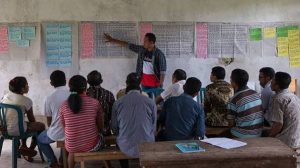
English learning in rural Indonesian public schools faces more complex challenges than schools in urban areas. Limited infrastructure, large number of students in a class, lack of access to modern learning media, and low exposure to English in the daily environment are major obstacles. In addition, many students in rural areas experience high language anxiety due to lack of confidence and communication experience. Teaching methods that are still dominant are teacher-centered and memorization-oriented and often lack of psychological barriers. Suggestopedia, a method developed by Georgi Lozanov with an emphasis on relaxation, positive suggestions, and a pleasant learning atmosphere, offers an exciting opportunity to be implemented in rural contexts. Despite coming from different backgrounds, the basic principles of Suggestopedia can be creatively adapted according to local conditions so that it has the potential to increase the motivation and English proficiency of public school students in rural Indonesia.Theoretically, Suggestopedia is based on the belief that human learning capacity is much greater when affective barriers such as fear, tension, and low self-esteem are minimized. This method utilizes music, movement, role-play, and positive suggestions from teachers to create relaxation conditions that support the absorption of language inputs. Within the framework of Krashen’s affective filter theory, a comfortable atmosphere allows students to receive language more optimally. In rural public schools, where academic pressure and limited facilities often reinforce students’ sense of security, an approach that emphasizes psychological comfort becomes particularly relevant. The elements of Suggestopedia do not necessarily require advanced technology; the main thing is the teacher’s ability to create a supportive learning environment. Thus, the theoretical foundation of this method is in line with the needs of rural students who need to strengthen motivation and confidence before they can develop language skills effectively.
The opportunity to implement Suggestopedia in rural Indonesian public schools is quite open if it is done with the right adaptation. Teachers can take advantage of available local resources, for example using traditional local music instead of baroque music to create a culturally familiar atmosphere of relaxation. Simple classrooms can be minimally rearranged by sitting in a circle or using the floor as a relaxation area. Dialogue and listening materials can be presented through oral stories or role-plays involving the theme of rural life, making them more meaningful to students. Positive suggestions can be given consistently in easy-to-understand language, emphasizing that every student is able to learn English. Activation activities such as language games, singing, or short plays do not cost a lot but can increase participation. By harnessing the power of community and local wisdom, Suggestopedia has the potential to be a method that not only reduces anxiety, but also builds students’ emotional engagement with English language learning. Time constraints due to a dense curriculum, high administrative burden on teachers, and lack of training on non-conventional methods are major obstacles. Large class sizes make it difficult to create an ideal atmosphere of relaxation, while the lack of support from principals or supervisors can reduce the sustainability of the program. In addition, the perception by some teachers and parents that learning should be serious and exam-oriented can hinder acceptance of a seemingly “relaxed” approach. To overcome these challenges, a gradual strategy is needed: starting with a short session of Suggestopedia at the beginning of the lesson, integrating elements of this method into familiar communicative approaches, and leveraging teacher working groups to share good practices. Support in the form of simple training at the group level or local education office is also very necessary so that teachers feel more confident in trying new approaches.
Overall, Suggestopedia has a promising opportunity to be implemented in rural public schools in Indonesia when adjusted to existing local limitations and potential. This method can help overcome the affective barriers that have been hindering the development of students’ English language skills, while creating a more humane and enjoyable learning environment. The success of its implementation is highly dependent on teacher creativity, institutional support, and adaptation to the local cultural context and resources. Although it is not a single solution, Suggestopedia can be a valuable complement to existing learning practices. Limited research and trials in various rural schools are highly recommended to identify the most effective adaptation model. Thus, the opportunity to implement Suggestopedia is expected to contribute to efforts to equalize the quality of English learning throughout Indonesia, including in areas that have been less accessible by pedagogical innovation.
#suggestopedia
#georgilozanov
#ikafarihahhentihu