Adaptation of Local Culture-Based Suggestopedia Techniques for English Teaching in Indonesian Elementary Classrooms

English teaching in Indonesian elementary schools faces complex challenges that include students’ limited vocabulary, shyness of speaking, and lack of exposure to the target language outside the classroom. The Suggestopedia method developed by Georgi Lozanov offers a unique approach through the use of positive suggestions, relaxation, and a supportive learning environment to maximize the brain’s capacity to absorb language. However, the pure application of this method in Indonesian elementary school classrooms requires in-depth adaptation to suit the developmental characteristics of children aged 7–12 years and the local socio-cultural context. The integration of local cultural elements such as folklore, traditional songs, traditional games, and local wisdom values is key to increasing the relevance and effectiveness of learning. This article discusses the framework for adapting Suggestopedia techniques based on local culture, its potential benefits for elementary school students’ English language skills, and practical considerations for its implementation in Indonesian classrooms. By associating the principles of Suggestopedia with the cultural identity of Indonesian children, it is hoped that a learning experience that is not only linguistically effective, but also strengthens cultural confidence and pride.

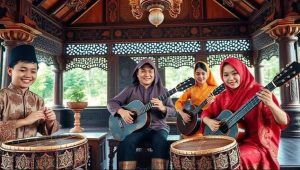
Theoretically, Suggestopedia emphasizes the elimination of psychological barriers through three main phases: material presentation (decoding), concert sessions with music (concert sessions), and activation of knowledge through creative activities. In the context of Indonesian elementary schools, these phases can be adapted by replacing foreign elements with local elements that are familiar to students. Baroque music is replaced with traditional instruments such as gamelan, angklung, or regional music that is soft and rhythmic in a regular rhythm to create an atmosphere of relaxation. Dialogue or story material is presented through adaptations of folklore such as “Malin Kundang”, “Timun Mas”, or local legends translated and simplified into simple English. Activation activities utilize traditional games such as congklak, engklek, or modified hide and seek with English instructions. This approach is in line with contextual learning theory and the concept of funds of knowledge, where the cultural knowledge that students have becomes a bridge to mastery of a new language. In addition, limited use of mother tongue in the early stages helps to reduce anxiety, while positive suggestions delivered by teachers in the local language strengthen the child’s sense of emotional security.

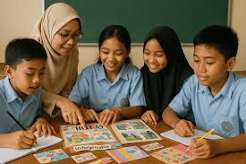
The implementation of this adaptation can be carried out through a thematic learning design that is integrated with the Independent Curriculum. In the preparation stage, teachers identify local cultural elements that are relevant to the learning theme, such as “Family”, “Environment”, or “Hari Raya”. Each session begins with a short relaxation activity using simple movements inspired by regional dances or traditional gymnastics while local music is played. Next, the teacher presents stories or dialogues in English with expressive intonation, followed by a recording listening session accompanied by music. The activation phase involves folklore-based role-plays, the singing of a local song whose lyrics are partially replaced with English vocabulary, as well as group play that encourages verbal interaction. Assessment is carried out formatively through observation of student participation, fluency in speaking, and confidence, not solely grammatical accuracy. This model takes into account the limitations of facilities in many elementary schools, so it can be run with simple tools such as portable speakers, posters with pictures of local stories, and properties of recycled materials.

The results of conceptual studies and limited practical experience show that the adaptation of Suggestopedia based on local culture is able to significantly increase student motivation and participation. Students tend to remember vocabulary and sentence structure more easily because they are connected to narratives they are already familiar with. A pleasant classroom atmosphere lowers the level of speech anxiety, so that children are more courageous to produce speech even though it is still simple. Affective aspects such as pride in one’s own culture also develop along with mastery of English. However, there are several challenges, including the ability of teachers to adapt the material creatively, the availability of time for preparation, and the need for special training on relaxation techniques and suggestion-based classroom management. In areas with high ethnic diversity, the selection of cultural elements must be carried out in an inclusive manner so as not to create gaps. Factors that support success include collaboration with parents in providing local stories, support from the principal, as well as integration with other subjects such as Cultural Arts and Indonesian Language.Based on the description above, the adaptation of Suggestopedia’s techniques based on local culture is a promising strategy for teaching English in Indonesian elementary school classrooms. This approach not only overcomes students’ psychological and linguistic barriers, but also strengthens cultural identity in the process of globalization of education. Practical recommendations include the development of teacher training modules that focus on the integration of local culture with the principles of Suggestopedia, the preparation of digital material banks containing simple English folklore, as well as advanced empirical research with quasi-experimental designs in various regions of Indonesia. Thus, learning English in elementary school can be a safe, fun, and meaningful space, where Indonesian children not only learn foreign languages, but also increasingly appreciate their own cultural roots. This effort is in line with the goal of national education to form a globally competent generation with a local character.

#suggestopedia

#georgilozanov

#teachingmethod

#ikafarihahhentihu


Implementation of Suggestopedia on Speaking Learning in Indonesian Junior High School: A Case Study

The Suggestopedia method developed by Georgi Lozanov in the 1970s is a language learning approach that emphasizes the use of positive suggestions, relaxation, and a supportive learning environment to optimize the brain’s capacity to absorb information. In the context of learning English in Indonesia, especially speaking skills in Junior High School (SMP), this method is relevant because many students still experience psychological obstacles in the form of fear of being wrong, anxiety speaking, and lack of confidence. This case study was carried out in one of the public junior high schools in the city of Bandung for one semester involving two classes VIII consisting of 64 students. The research aims to describe the implementation process of Suggestopedia, identify changes in students’ speaking abilities, and analyze the supporting and inhibiting factors that arise in the field. Data were collected through classroom observations, interviews with teachers and students, and assessments of speaking practice before and after treatment. Preliminary results show that a classroom environment transformed into more comfortable with soft lighting, classical instrumental music, and English-language motivational posters was able to significantly lower students’ anxiety levels. Thus, this research contributes to the development of more humanistic and effective teaching practices in Indonesian junior secondary education.Theoretically, Suggestopedia is based on the principle that psychological barriers or “anti-suggestive barriers” can be eliminated through a combination of direct and indirect suggestions. Lozanov divides the learning process into three main phases: decoding (presenting material), concert sessions (presentation with music), and activation (activation of knowledge through games and dialogues). In the context of speaking, the concert session phase is crucial because students listen to English dialogues or monologues while in a relaxed state, so that linguistic input enters long-term memory without pressure. Previous literature in various countries shows the success of this method in improving speaking fluency, but its application in Indonesia is still limited and rarely focused on the junior high school level. In Indonesia, the Independent Curriculum emphasizes student-centered learning and the development of communicative competencies, so that Suggestopedia can be a harmonized alternative. However, adaptation is necessary given the socio-culturally diverse characteristics of Indonesian students, as well as the limitations of facilities in many public schools. This case study fills this gap by presenting a real picture of the application of the method in junior high school speaking classes which have a relatively large number of students and limited time allocation.

The implementation of the case study is carried out through the stages of preparation, implementation, and evaluation. In the preparation stage, teachers are trained for two days on the basic principles of Suggestopedia, classroom management techniques, and the selection of music and speaking materials that are in accordance with the ability level of grade VIII students. The material used includes topics such as describing people, daily routines, and giving opinions that are tailored to the learning outcomes of the Independent Curriculum. The implementation lasted for 12 meetings, 80 minutes each. Each session begins with a short relaxation activity (breathing exercise) for five minutes, followed by a dialogue presentation by the teacher with expressive intonation while playing soft Indonesian baroque or classical music. Students were then asked to close their eyes and listen to a recording of the dialogue, followed by a paired role-play activity in a non-judgmental setting. The speaking assessment is carried out using rubrics that include fluency, accuracy, pronunciation, and confidence. Observations showed that at the third to fifth meetings, students began to show more active participation, while at the eighth to twelfth meetings, most students were able to produce longer and more spontaneous speeches.

The results of the study revealed a significant improvement in students’ speaking skills. The average pre-test speaking score of 62.4 increased to 78.9 in the post-test, with the confidence aspect experiencing the highest increase. Qualitative analysis of interviews showed that students felt more courageous to speak up because of the pleasant classroom atmosphere and no punishment for mistakes. Teachers also reported that the use of music and visual elements helped to retain students’ attention longer than conventional methods. However, several challenges have arisen, including difficulties in maintaining a consistent atmosphere of relaxation when classes are crowded, limited audio equipment in the classroom, and adaptation of students who are used to the teacher-centered approach. Factors that support success include teachers’ commitment to creating a positive classroom climate, the support of the principal in providing simple facilities, and students’ enthusiasm for activities involving movement and language games. These findings are in line with Lozanov’s theory that positive suggestions can accelerate language acquisition, while emphasizing the importance of contextualizing methods according to Indonesian school conditions.

Based on the findings of the case study, it can be concluded that the implementation of Suggestopedia in speaking learning in Indonesian junior high schools has a positive impact on students’ communicative skills and affective aspects. This method not only improves fluency and confidence in speaking, but also creates a more meaningful learning experience. Recommendations that can be given are the need for continuous training for English teachers on adaptive Suggestopedia techniques, the development of locally-based teaching materials that are integrated with Indonesian music and stories, as well as advanced research with experimental designs involving more schools and longer durations. Although there are limitations in generalization due to the nature of the case study, the results of this study provide empirical evidence that an approach that pays attention to the psychological aspects of students is worth considering in an effort to improve the quality of speaking learning at the junior secondary level. Thus, Suggestopedia can be one of the innovative strategies to support the achievement of communicative English language competencies among Indonesian adolescents.

#suggestopedia

#georgilozanov

#teachingmethod

#ikafarihahhentihu

What is Suggestopedia Teaching Method by Georgi Lozanov?

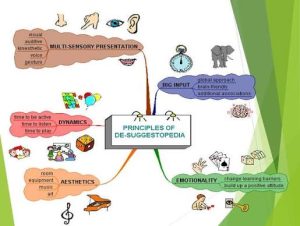
The Suggestopedia method (or sometimes called Desuggestopedia in newer versions) is one of the most unique and revolutionary approaches to foreign language teaching. This method was developed by Georgi Lozanov, a Bulgarian psychiatrist and educator, in the 1970s. Lozanov is based on a science he calls suggestology, which is how positive suggestions and the elimination of negative suggestions can take advantage of the enormous potential of the human brain (he claims that humans only use 5–10% of their mental capacity because of many “psychological limitations” that are instilled from childhood). Suggest TopRemoving psychological barriers (such as fear of being wrong, feeling “I can’t speak a foreign language,” learning stress, etc.) so that students can learn quickly, relaxed, and fun — similar to a child absorbing mother tongue without pressure. Lozanov claims that this method can accelerate language learning by 3-5 times compared to conventional methods. Main Principles of Suggestopedia (according to Lozanov)Joy and absence of tension → Cheerfulness and calmness (learning should be fun, without pressure or fear).

Unity of conscious and subconscious → Integrating the conscious and subconscious minds.

Suggestion & desuggestion → Giving positive suggestions (“You can learn easily”) and eliminating negative suggestions (“Learning a language is hard”).

Authority & infantilization → The teacher acts as a loving authority figure (like a parent), while the student is invited into a spontaneous and open “child-like” state.

Double-planeness → There are direct messages (words) and indirect messages (the atmosphere of the room, music, the teacher’s movements).

Rhythm, intonation, concert pseudo-passivity → Material is presented with special rhythms, intonations, and music to be easily absorbed into the subconscious.

Technique and Implementation in the ClassroomSuggestopedia classes usually feel very different from regular classrooms: The room is comfortably decorated, such as a living room or lounge (padded chairs, carpets, beautiful posters, soft lighting—not row chairs like a regular school).

The teacher was neatly dressed and authoritative, but friendly and passionate.

Baroque classical music (about 60 beats per minute, such as Vivaldi, Bach, Handel) is played to create a state of alpha relaxation (the brain relaxes but remains alert).

There are 3 main stages in a lesson session: Preparation / Pre-session

The teacher gives positive suggestions, students are invited to relax (sometimes with breathing techniques or light yoga), eliminating fear.

Concert session (core part) Active concert: The teacher reads a long dialogue with dramatic intonation and loud background music → students join in the reading while looking at the text.

Passive concert: Students sit relaxed or half-lying down, eyes closed, the teacher reads the dialogue again in a soft voice & slow Baroque music → students listen only passively (material “enters” into the subconscious).

Post-session / Activation

Students are invited to practice communicative practices creatively: role-play, singing, drama, games — without excessive error correction to stay relaxed.

Advantages & CriticismAdvantages: Students feel comfortable and confident in learning the language.

The vocabulary & structure of the language can be remembered very much in a short time.

Suitable for overcoming high affective filters (language learning stress).

Criticism: Too reliant on suggestions & atmosphere → difficult to apply in a cheap & large regular class.

The claim of 3–5x acceleration is considered exaggerated by some researchers.

Less focus on language production (speaking & writing) than comprehension.

It is sometimes considered to be similar to “mild hypnosis” or too “mystical”.

In Indonesia, this method is sometimes used in certain language courses or creative teachers who want to experiment, although it is rarely full because it requires special preparation.

#suggestopedia

#teachingmethod

#georgilozanov

#ikahentihu