
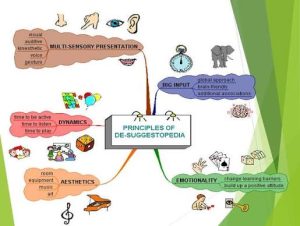
English Speaking Anxiety is one of the most significant affective barriers faced by students in Indonesia in the foreign language learning process. Many students experience tension, fear of making mistakes, and worries of negative judgments from teachers and peers when asked to speak in front of the class. This condition is often associated with a high affective filter as stated by Stephen Krashen, which inhibits language input into the acquisition system. In the context of Indonesian education, where English is generally learned as a foreign language and rarely used outside the classroom, the phenomenon of speaking anxiety is increasingly real. Conventional methods that emphasize grammatical accuracy and direct correction tend to exacerbate these tensions. Suggestopedia, a teaching method developed by Georgi Lozanov, offers an alternative approach by utilizing positive suggestions, baroque music, relaxation, and a pleasant learning atmosphere to lower psychological barriers. The analysis of the effectiveness of this method is important because it has the potential to provide practical solutions for English teachers in Indonesia in creating a learning environment that is more supportive of students’ speaking skills. Suggestopedia is based on the principle that human learning capacity is much greater than is usually utilized, and the main obstacle lies in fear and emotional tension. This method consists of three main phases: presentation of material through dramatic dialogue accompanied by music, activation sessions in which students take an active role in a relaxed atmosphere, and consolidation sessions that strengthen memory through pleasant repetition. Baroque music with a certain tempo is used to create a state of relaxation similar to the alpha state of the brain, thus facilitating the absorption of information. In addition, teachers act as facilitators who provide positive suggestions about students’ abilities, avoid direct criticism, and build confidence through role-play and games. Within the framework of foreign language anxiety theory, this approach directly targets the cognitive, affective, and behavioral components of speaking anxiety. By lowering levels of excessive alertness and shyness, Suggestopedia allows students to focus more on the meaning of communication rather than on formal mistakes. This theoretical foundation has become relevant in Indonesia because many students have a learning experience dominated by teacher-centered approaches and error-based assessments.
Several empirical and practical studies in various contexts, including in Asia, have shown that the application of Suggestopedia can significantly lower speech anxiety scores. Although specific research in Indonesia is still limited, similar findings from countries with similar foreign language learning conditions provide positive indications. Students who participated in Suggestopedia sessions tended to report a decrease in fear of speaking, increased courage to participate, and improvements in fluency despite imperfect grammatical accuracy. Elements such as the use of dialogue scripts with humorous elements, comfortable classroom decorations, and the absence of direct correction during the activation phase help to create psychological safety. In Indonesian classrooms, which are often heterogeneous in ability, this method allows low-ability students to participate without feeling threatened. However, its effectiveness depends on the teacher’s skills in managing the atmosphere, the choice of appropriate music, and the adaptation of the material to the local culture. When implemented properly, Suggestopedia not only reduces anxiety but also increases intrinsic motivation and vocabulary retention in the short term.
However, the implementation of Suggestopedia in Indonesia faces a number of contextual challenges. Time constraints in a crowded curriculum, large number of students in a class, and lack of teacher training on non-conventional methods are major obstacles. In addition, the perception by some teachers and parents that learning should be serious and exam-oriented can reduce acceptance of a seemingly “playful” approach. The collectivist culture in Indonesia also influences, where the fear of losing face is still strong, so positive suggestions need to be combined with group reinforcement strategies. The availability of audio devices for baroque music and classrooms that support relaxation is not always adequate in regional schools. Therefore, local adaptation is key: teachers can take advantage of calm traditional music, dialogue relevant to the daily lives of Indonesian students, and integration with other communicative approaches. Effectiveness evaluation also needs to be carried out systematically through instruments such as the Foreign Language Classroom Anxiety Scale (FLCAS) speaking version before and after the intervention, accompanied by observation of student participation.
Overall, the analysis shows that Suggestopedia has substantial potential in reducing English speaking anxiety among Indonesian students when adapted contextually and implemented consistently. This method works by lowering affective filters, building confidence through positive suggestions, and creating a pleasant learning experience so that students are more confident in using the language productively. Although it is not a single solution and requires training support and curriculum adjustments, Suggestopedia can be a valuable complement to the commonly used communicative approach. Further research at various levels of education in Indonesia is needed to measure the long-term impact on speaking competence and learning motivation. Thus, the integration of Suggestopedia elements into daily teaching practices is expected to help Indonesian students not only master the structure of language, but also be able to communicate more confidently and effectively in a global context.
#suggestopedia
#georgilozanov
#ikafarihahhentihu