
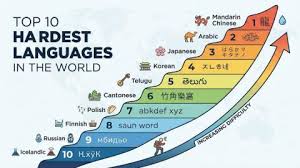
According to the Foreign Service Institute (FSI) of the United States, the most difficult languages for English speakers fall into Category IV or “super-hard languages”, namely Mandarin, Arabic, Japanese, and Korean, which require about 2,200 hours of lessons to achieve professional proficiency. Chinese is often ranked at the top because of its tone system consisting of four main tones plus neutral tones, where incorrect pronunciation can change the meaning of the word completely—for example, “ma” can mean mother, horse, bile, or bruise depending on the intonation. In addition, the logographic Hanzi writing system requires learners to memorize thousands of characters, each with a different meaning and often pronunciation. This complexity is exacerbated by the lack of similarity of vocabulary with Indo-European languages, so learners must build a foundation from scratch without the help of cognates. Cultural factors and the context of use also add to the challenge, as understanding Chinese involves not only grammar but also subtle social norms. Linguistic research shows that the brains of non-native learners must develop new abilities in auditory and visual processing that are much different from alphabetic languages.
Arabic follows as one of the most challenging due to its writing system based on the consonant alphabet, where vowels are often unwritten and must be guessed out of context. The language has a unique root system, where three basic consonants can produce dozens of derived words with related meanings, but require a deep understanding of morphological patterns. The extreme variety of dialects between countries—from Modern Standard Arabic (MSA) used in the media to everyday dialects such as Egyptian or Levantine—means that students have to master two variants at the same time. Pronouncing letters such as ‘ayn, ghayn, and qaf is difficult for Indonesian or English speakers because it involves throat sounds that are rarely present in their native language. In addition, the direction of writing from right to left and grammatical rules involving gender, numbers, and cases add to the cognitive load. Studies show that learners take longer to achieve reading and listening fluency due to the deep literary and rhetorical richness in the Arabic tradition.
Japanese and Korean are also among the most difficult groups due to their unique combination of writing systems and grammatical structures. Japan uses three writing systems at once: Hiragana, Katakana, and Kanji (thousands of characters adopted from Hanzi but with different pronunciations and meanings). Japanese grammar is agglutinative with particles indicating word functions, as well as complex levels of subtlety (honorifics) based on social hierarchy. Meanwhile, Korean has Hangul that is phonetic and relatively easy to learn, but its grammar is highly context-dependent, a more complex honorific system, and flexible word order. These two languages have little in common with Austronesian or Indo-European languages, so there is almost no transfer of linguistic skills. Psychological factors such as motivation and exposure to pop culture (anime, K-dramas) can help, but cognitive research confirms that processing Korean kanji or sentence patterns requires significant neural adaptation. Languages such as Hungarian, Finnish, and Basque are also often said to be difficult due to their extreme agglutinative grammar and non-Indo-European vocabulary, although they have fewer speakers.
Overall, language learning difficulties are determined not only by linguistic distance but also by neuropsychological, cultural, and environmental factors. Technological advancements such as AI-based applications, virtual reality immersion, and evidence-based teaching methods have reduced the time required, but they have not eliminated fundamental challenges. For Indonesian speakers, the difficulty can be slightly reduced in certain phonetic aspects, but still high in the writing and tone systems. Understanding the reasons behind these difficulties not only helps prospective learners prepare the right strategies—such as focusing on tone first for Mandarin or dialect hearing practice for Arabic—but also provides a deeper appreciation of the diversity of human languages as a reflection of the complexity of the mind and culture. With dedication and the right approach, even the most difficult language can be mastered, opening the door to a wider global understanding.
#language
#hardestlanguage
#ikahentihu