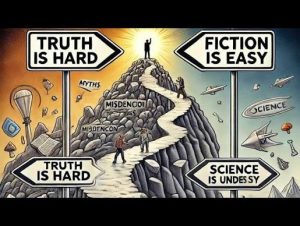
Scientific Truth, Can It Be Hard to Come By?

Scientifically, if a study is true and strong, it should be relatively easy to test or verify it. Science works on very simple but stubborn principles. Claims must be testable, retestable, and anyone using the same method will arrive at similar results. Replication is key.

If someone’s research states something factual, there are several lines of proof that usually occur.

First, the data can be checked by others. The dataset is opened, the method is described, the analysis steps are transparent. Skeptics are actually happy with this kind of situation because they can try to refute it.

Second, the results can be replicated. Other researchers tried the same procedure. If the results are consistent, trust increases. Otherwise, the claims start to collapse.

Third, the argument must be stronger than the alternative explanation. In science there is a simple principle that is often used. The simplest explanations that fit the data are usually more likely to be true. Occam’s razor is his name.

In the real world, the problem is rarely purely scientific. There is psychology, identity, reputation, and even politics. People can remain distrustful even if the data is available. This phenomenon is known in cognitive psychology as confirmation bias. The human brain tends to like information that corroborates initial beliefs.

The history of science is full of strange examples like this. Alfred Wegener had already proposed the theory of continental shifts in 1912. The geological evidence is actually quite strong. Many scientists laughed at it for decades. It wasn’t until the 1960s that evidence of the ocean floor emerged that the theory was accepted as plate tectonics.

This means this. Scientific truth does not always win out in public debate. He wins slowly through the accumulation of evidence and the ability of others to verify.

If the research is methodologically correct, the most powerful path is not convincing a particular individual. The most powerful path is to open up the methods, open up the data, and then let the research community test it. If it escapes a lot of criticism, rational skeptics will usually change positions because the evidence is starting to be too heavy to ignore.

Science has interesting habits. He doesn’t care who is right. He only cares about what can be proved. That’s where the power lies as well as the drama.

#science

#alfredwegener

#ikafarihahhentihu
Paranoia AI on Campus and the Crisis of Scientific Assessment

There is an anxiety that is secretly growing in academic spaces. This anxiety does not depart from data errors or weak methodologies. It actually appears when a piece of writing sounds too neat, too systematic, too clean. Suspicion is immediately directed at a single source of AI.

Here it feels like something has shifted. When language becomes the main measure of scientific truth. When an orderly structure actually triggers suspicion. Science stands on argument, verification, and openness to rebuttals. It’s not about whether a sentence sounds human enough.

This phenomenon shows a change in the way of judging that is quite worrying. Academics who should be critical of the claims, are actually trapped in the impression. The work was rejected not because it was weak in substance, but because it was considered “AI-detectable”. Even though the detection tool itself does not have strong methodological reliability. A new type of error appears. It is no longer a mistake in the content of knowledge, but a mistake in identifying knowledge itself. At this point we are dealing with what could be called a _false positive_ of knowledge. A valid, legitimate, and thought-based work is marked as inauthentic just because of its language style.

The irony is becoming more and more apparent. The academic world has been building formal, impersonal, and consistent language standards. That standard can now be replicated by machines. Instead of being a source for reflection, this situation actually gives birth to rejection. It’s as if we’re rejecting our own imagination because it’s too precise.

AI is then positioned as an epistemic threat. Bias and hallucinations are raised as the main arguments. This criticism is relevant, but it feels disproportionate. Every knowledge tool contains bias. Every human being brings limitations. The difference is that with AI we demand absolute certainty. Towards humans, we give room for tolerance.

The impact is starting to be felt in scientific practice. Suspicions that are _default_ do not improve quality. Instead, he narrowed the exploration space. Researchers have become more careful not in thinking, but in hiding their way of thinking. Transparency turns into a threat. This is contrary to the basic principles of science that demand openness of process.

There are logical fallacies that keep repeating. The use of AI is considered equivalent to the submission of reason. Even though the relationship is not that simple. Just as the use of statistical tools does not eliminate analysis, AI does not eliminate reflections either. It accelerates articulation, not replaces thought. The subject of thinking remains human, only the medium changes.

This situation has deeper consequences. The way we judge knowledge is starting to blur. Validity shifts to perception. Arguments are defeated by suspicion of style. _False positive_ knowledge becomes a new phenomenon that undermines epistemic beliefs. Works that are worthy of testing are stopped before being examined.

The questions that arise feel uncomfortable. What exactly is feared. The risk of scientific error, or loss of control over the standards of knowledge production. If AI is able to help formulate ideas faster and more neatly, then those old advantages fade, what is being maintained.

Science is not determined by tools. It is determined by the integrity of the process. The argument must be testable. The data must be verifiable. Claims must be accountable. As long as it is fulfilled, the medium of expression becomes a secondary problem.

Perhaps what needs to be reviewed is not the technology. The way we interpret authenticity needs to be corrected. Originality is not always present in style. He lived in correctness of thought and the courage to be tested. If it still exists, then suspicion of machine language reflects more human anxiety than a crisis on science itself.

#AI

#campus

#science

#ikafarihahhentihu