
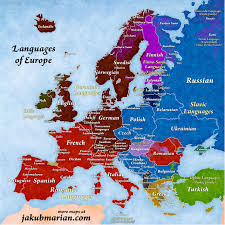
Europe is often referred to as the smallest continent in the world, but its linguistic richness is incredible. More than 200 languages and dialects live in the region, from the Atlantic Ocean to the Ural Mountains. European languages are not just a means of communication, but a reflection of the history of national migration, royal conquest, and cultural exchange over thousands of years. From the Latin that was the root of the Romance language to the Viking influences that shaped the Scandinavian language, Europe is a living linguistic laboratory. This diversity is increasingly felt in the European Union, which now has 24 official languages, plus dozens of protected minority languages. Each language carries a unique identity, from the soft Italian accent to the emphatic rhythm of German, creating a cultural mosaic that makes Europe so captivating. Even in today’s digital age, European languages are constantly evolving, adapting to technology while retaining their deep ancient roots.
The majority of European languages come from the Indo-European family, the world’s largest language family that covers about 90 percent of the continent’s population. This clump is divided into several main branches that are very different. Romance languages, of Latin descent, include French, Spanish, Italian, Portuguese, and Romanian; These languages are gentle and romantic, widely used in art, literature, and diplomacy. Meanwhile, the Germanic branch produced a more assertive and efficient English, German, Dutch, Swedish, and Danish languages, with a very strong global influence thanks to British colonialism and German economic power. The Slavic branch includes Russia, Poland, Czechoslovakia, Bulgaria, and Ukraine, which are rich in consonants and are often associated with epic literature as well as imperial history. There are also the almost extinct Celtic branches such as Ireland and Wales, as well as the Greek and Albanian languages that stand alone as single branches. This diversity shows how the migrations of ancient tribes such as the Aryans, Romans, and Slavs have shaped the complex and interconnected linguistic map of Europe.
Not all European languages are of Indo-European origin. Some of them are living proof that Europe was once home to older ethnic groups. Uralis, such as Finnish, Hungarian, and Estonian, are not at all related to Romance or Germanic; its origins are precisely from the Siberian region thousands of years ago. The Basque languages of Spain and France are isolated languages that have no close relatives, so linguists are still solving the mystery of its origins today. The Turkish language in European Turkey and some communities in the Balkans also adds color, while the Sami language in Northern Scandinavia reflects the life of indigenous peoples in the Arctic circle. These minority languages are often endangered due to the dominance of national languages, but revitalization programs in the European Union have managed to keep dozens of them alive, including Breton in France and Sorb in Germany. Their existence reminds us that Europe is not a monolithic continent, but rather a mosaic full of surprises.
The history of the evolution of European languages cannot be separated from major world events. The Roman conquest spread Latin throughout Western and Southern Europe, which later evolved into the modern Romance language. The invasion of the Germanic nations in the Middle Ages brought Germanic roots to Britain and Scandinavia, while the Ottoman Empire introduced Turkish elements to the Balkans. The Enlightenment and Industrial Revolution made French and English the languages of international diplomacy and science. In the 20th century, World War II and the Cold War affected the status of Russian and German languages, while globalization made English dominate business and the internet. Currently, the European Union actively promotes multilingualism through the Erasmus program and education policies that require students to learn at least two foreign languages. European languages also continue to be influenced by immigration and technology; Words like “selfie” or “hashtag” are now part of almost all languages on the continent.
In the midst of the challenges of globalization and artificial intelligence, European languages remain a vital cultural bridge. Language is not just a means of communication, but a living heritage that carries stories, values, and identities. The European Union is investing billions of euros in the preservation of minority languages, while translation and online learning apps are making European languages more accessible to younger generations around the world. Going forward, European languages will continue to evolve, perhaps with more borrowed words from Asia and Africa, but their rich roots will remain the foundation of the continent’s diversity. For travelers, students, or business people, understanding the European language means opening the door to the hearts of its people. Thus, the languages of Europe are not just words, but the soul of the continent that continues to sing in various rhythms, from Paris to Moscow, from Lisbon to Helsinki.
#europe
#europeanlanguages
#indo-europe
#ikahentihu
