
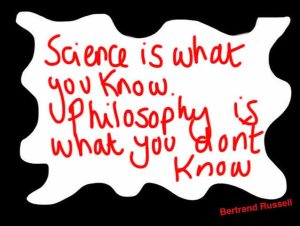
There is one course that often makes students sigh before the lecturer finishes mentioning his name: philosophy of science.
In class, faces begin to go blank. Laptops are open, but not for taking notes. Some are busy with their phones. Others are waiting for the lecturer to mention assignments and exam forms. There is a kind of tacit agreement: these courses must be skipped because they are in the curriculum.
Interestingly, I suspect that the problem is not with the students.
Maybe we have been misintroducing the philosophy of science.
We teach ontology, epistemology, axiology, positivism, rationalism, empiricism, phenomenology, paradigm and a series of other terms. Students take notes. Then memorize. After the exam, most of them are gone.
Then we ask why students don’t like philosophy of science.
The question may need to be reversed: why should they like it if we introduced it as a collection of terms in the first place?
Even though the philosophy of science actually deals with questions that are very close to their lives.
Take AI for example.
A company uses artificial intelligence to predict students who have the potential to fail college. The system has an accuracy of 92 percent.
The question is simple: can we trust it?
Informatics students may be immediately interested. What is the algorithm? What is the dataset? How is the accuracy calculated?
But the philosophy of science starts to work when we ask the next question.
What exactly does “true” mean?
If the system is able to predict which students will fail with 92 percent accuracy, does that mean that the system understands why the student failed?
Not necessarily.
Maybe the system just finds patterns: low attendance, decreased assignment scores, reduced activity on the learning platform. Statistically it is very good. But is “student at risk of failure” really an objective fact, or is it just a category that we create through the model?
That’s where epistemology comes in.
How do we know that the knowledge generated by the algorithm is trustworthy?
Then the methodological question arises: how is the data collected? Is the sample representative? Is there bias? Are the variables used relevant?
Then ontology asks something more fundamental: what exactly is the object we are measuring?
And when that system is used to determine who gets academic help first, axiology comes in.
Was the decision fair?
What if the algorithm turns out to be more likely to mark students from certain groups as “at risk”?
Here the philosophy of science ceases to be memorization.
It becomes a brake for science and technology to not run just because something can be calculated, predicted, or created by machines.
The problem is that our education is often too busy teaching students how to produce knowledge, but it does not give enough space to ask whether it is worthy of being trusted and used.
A programmer can create algorithms.
A data scientist can find patterns.
A researcher can come up with numbers.
But who questions whether the algorithm is fair, whether the pattern is meaningful, whether the numbers are enough to make a decision?
That’s where the philosophy of science has a reason to stay alive.
Even in the midst of the age of AI.
In fact, the more sophisticated the technology, the more important it is that humans have the ability to doubt what seems convincing.
AI can provide answers in seconds. But the speed of generating an answer doesn’t automatically make the answer correct.
Algorithms can find correlations. But correlations don’t automatically explain why.
Data can be huge. But the amount of data doesn’t automatically make scientific conclusions.
And a study can use very complicated methods, but still generate a simple question: what are we actually knowing?
Perhaps because of this, philosophy of science should not be taught as a course about philosophers.
It should be taught as a course on doubt.
Doubts about what we consider to be true. Doubts about how we acquire knowledge. Doubts about numbers, methods, technology, even our own conclusions.
Students do not need to be made to love philosophy.
Much more importantly, they need to be made a little harder to be lied to by something that looks scientific.
Including by AI.
And perhaps that’s the most plausible reason why philosophy of science still needs to be taught at universities.
#philosophy
#epistimology
#ikafarihahhentihu