
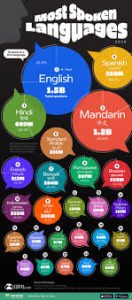
Its speakerLanguage is one of humanity’s most remarkable achievements, serving not only as a means of communication but also as a carrier of cultural identity, knowledge and history. In a world of more than 7,000 languages, there is a stark contrast between the languages with the most and the fewest speakers. According to the latest edition of Ethnologue data (2026), English dominates as the language with the most total speakers reaching around 1.5 billion people, including native speakers and second speakers. Meanwhile, Chinese Chinese excels in the native speaker (L1) category with nearly 988 million to 1.2 billion speakers. These differences reflect the dynamics of globalization, historical colonialism, and economic-political forces. These major languages are widespread due to factors such as trade, education, media, and migration, thus becoming the lingua franca in different parts of the world. On the other hand, hundreds of small languages are on the brink of extinction with only a handful or even one speaker remaining, threatening to lose invaluable global linguistic diversity. This comparison not only highlights demographic imbalances, but also implications for cultural preservation and human linguistic sustainability.
The development of English as the most widely spoken language cannot be separated from the history of the British Empire and the dominance of the United States after World War II. With native speakers of about 372 million people, the language has soared thanks to more than 1.1 billion second speakers who use it for business, science, technology, and entertainment. English is the official or semi-official language in dozens of countries, and dominates the internet, scientific publishing, and international diplomacy. In contrast, Mandarin Chinese, despite having the most native speakers, is more limited to the Chinese region and diaspora communities due to its complex writing system as well as its lack of global adoption compared to English. Large languages like these support social mobility and economic access, but they also create linguistic hierarchies where dominant languages often displace local languages. This phenomenon is known as language shift, where the younger generation prefers prestigious languages for advancement, thus accelerating the decline of minority languages. Linguistic studies show that about 88% of the world’s population speaks one of the 200 largest languages, leaving thousands of other languages with very limited speakers.
At the opposite end of the spectrum, the language with the fewest speakers is often an endangered indigenous language or linguistic isolate. Extreme examples include Taushiro in Peru and Tanema in the Solomon Islands, each of which has only one speaker left. Languages such as Ongota in Ethiopia (less than 10 speakers), Lemerig in Vanuatu (about 2 speakers), and Njerep on the Nigeria-Cameroon border are also in the critical category. These languages are typically spoken by small communities in remote areas, such as hunter-gatherer tribes or small island dwellers, who are vulnerable to disease, intertribal marriage, urbanization, and national language dominance. The extinction of language is not only the loss of vocabulary and grammar, but also the unique knowledge of the ecology, traditional medicine, and philosophy of the society. UNESCO estimates thousands of languages face serious risks in the next few generations, with more than 1,000 languages having fewer than 1,000 speakers. Preservation efforts through digital documentation, community revitalization programs, and bilingual education are crucial to prevent the permanent loss of this heritage.
The comparison between the most and the least spoken languages invites us to reflect on the dynamics of power and diversity in a global society. Major languages facilitate connectivity and progress, but often at the cost of marginalizing minority languages. In today’s digital age, technologies such as AI and language learning applications offer new hope for documenting and reviving rare languages, while global awareness of linguistic rights is on the rise. However, without active intervention from governments, communities, and international organizations, the rate of language extinction is expected to accelerate. Ultimately, maintaining a balance between global communication efficiency and the preservation of local diversity is a shared responsibility. Thus, the study of linguistics is not just about the number of speakers, but rather about valuing each language as a unique reflection of the human experience on Earth. Through this understanding, we can build a more inclusive future where all voices, both loud and almost lost, continue to resonate.
#spokenlanguage
#leastlanguage
#ikahentihu