
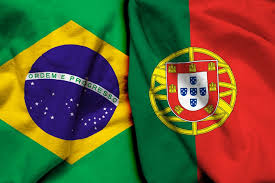
Portuguese is one of the most widespread Romance languages in the world, spoken by more than 250 million speakers as a mother tongue, mainly in Brazil and Portugal. Although both have their roots in the same Portuguese language that was brought to Brazil by colonists in the 16th century, the Brazilian variant (Português Brasileiro) and the European variant (Português Europeu) have experienced significant divergence over the centuries. These differences include phonology, vocabulary, grammar, and even prosody that often pose communication challenges between native speakers. Historically, geographical isolation, the influence of local languages (such as Tupi in Brazil and African languages), and different socio-economic developments have widened the gap between the two. However, both variants are still recognized as one and the same language in the official context, with considerable similarities at the level of formal writing.
The most striking difference lies in pronunciation (phonology and prosody ). Brazilian Portuguese tends to be syllable-timed, where each syllable is spoken of a relatively equal duration, resulting in a more open, melodic, and “singing” rhythm. The vowels are clearer and more open, while final consonants such as “l” are often vowelized to the “u” sound (e.g., papel is pronounced similar to “papéu”). In contrast, Portuguese Portuguese is stress-timed, with unstressed vocals that are often reduced or “swallowed”, making them sound faster, dense, and guttural. The “r” sound at the end of the word in Portugal is stronger and frictionless, while in Brazil it is often weakened or pronounced like an “h”. This difference makes it difficult for many Brazilian speakers to understand a quick conversation from Portugal, even though it is comparatively easier to converse.
In terms of vocabulary, the differences are also very real and often cause funny confusion. Many colloquial words are completely different: “bus” is called ônibus in Brazil but autocarro in Portugal; “train” is a tram versus a comboio; “refrigerator” became a refrigerator versus refrigerator; and “mobile phones” are celulars rather than mobile phones. Even simple words like “juice” (suco vs sumo) or “team” (time vs equipa) show quite deep lexical divergence. The influence of English is stronger in Brazil, while Portuguese Portugal retains more traditional and European-centric forms. However, context usually helps the speaker understand, similar to the difference between American English and British English.
The grammar also shows interesting variations. In Brazil, the use of the pronoun “você” (formal/informal) dominates and replaces the more common “tu” in Portugal. The use of gerund (-ndo, like estou lendo – I’m reading) is very prevalent in Brazil, while in Portugal it is more common to use the construction “estar a + infinitivo” (estou a ler). The placement of object pronouns and the use of subjects as direct objects are also different. In addition, the official spelling has been adjusted through the 1990 Orthographic Agreement, although some accent differences (acute vs circumflex) still exist. This difference reflects the natural evolution of languages influenced by the dynamics of society: Brazilians with large and multicultural populations tend to be more simplified in everyday use.
Overall, the differences between Brazilian Portuguese and Portuguese Portuguese are significant enough to reach about 30% on a lexical and phonological level, although they are still mutually intelligible with effort. For language learners, choosing a variant depends on the destination: Brazil for business, music, and pop culture, while Portugal for European diplomacy or classical traditions. In the era of globalization, the two variants are increasingly influencing each other through media and migration. Portuguese proves that a single language can evolve into two distinct yet connected “souls,” enriching the world’s linguistic diversity. Understanding these differences is important not only for linguists and translators, but also for anyone who wants to communicate effectively in the Lusophone world.
#brazil
#portugal
#ikahentihu
